4636 NW 10th Street
Oklahoma City, OK Winter 2009
Updated 11-20-09
Latest News
All this year's Quartz Mountain Live Oak Acorns are gone, but I did have a kind, satisfied customer just send me a packet of Q. fusiformis seeds. They were collected from a tree growing in a Botanical Garden in New Mexico (Zone 7a) labeled "Quercus fusiformis, Native to Oklahoma and Texas." I must stress that these are most likely NOT Quartz Mountain Live Oak, more likely from Central Texas, but they will still make nice, hardy trees. The best part is that these will be FREE, with any seed order, for the next few weeks, while they last. Just make a note in the "Special Instructions" box on the checkout page and you'll get 10 acorns added to your order at no extra charge! If you forget to add the note to the order form, just call or email before your order ships to let me know you want them.
These acorns have a short period of viability, so they won't be available for long.
Happy Holidays
Ocotillo, Small Yucca thompsoniana, Pitaya and Texas Rainbow Cactus are here, I'll try to get them on the page soon.

Excellent Book!!!
Palms Won't Grow Here and Other Myths
Warm-climate plants for cooler areas
Dr. David Francko, Botany Department Chair at Miami University in Ohio, has written the definitive (and only) book on growing Palms and other sub-tropical plants in areas with "real" winters. It contains many excellent photos and sections on microclimates, winter protection, plant cold tolerance mechanisms and much more. In addition to palms, it covers broad-leaved evergreens, deciduous trees and shrubs, bamboos, bananas, yuccas, cacti, agaves and more. If you are reading this page, you need this book!
308 pp, 78 color photos, 1 map, 31 b/w photos, 2 tables, 6 x 9", hardcover, © 2003
Palms Won't Grow Here, Book $27.95
Non-Contact Infrared Thermometers
Great gadget for plant hobbyists/professionals or weather junkies!
Find hot and cool spots, microclimates, soil temperatures and more instantly.
Easy to use, just point and read. Batteries and wrist strap included.
And shipping and handling is still only $5.00 for your entire order!
Two models are available. The smaller one is good for close range sampling from a few inches away. It has a range of -27F to +230F (easily switchable to -33C to +110C) a real-time clock, stopwatch and MAX/MIN/LOCK modes.
Infrared Thermometer, small $24.99
The larger unit has the same great features (no clock or stopwatch, though) and adds a red sighting laser, and an expanded temperature range to 482F (easily switchable to 250C). It has an adjustable emissivity setting for precise calibration, and a tight infrared "cone" distance to spot ratio (D:S) of 8:1. That means at a distance of 8 inches, you are reading an area just 1 inch in diameter. At a distance of 2 feet, an area of just 3 inches, as compared to the wider D:S ratio of 1:1 on the smaller unit.

Infrared Thermometer, w/Laser Sighting $49.99
Mail Order Plant Sale--While Quantities Last!
If you are in central Oklahoma or are planning a visit, be sure to drop by the store. We have all the plants listed below plus many, many more that we don't sell via mail-order, including numerous hardy bamboos, citrus, pond plants and more. Check out some of these on our Local Sales page.
For tips on establishing and growing your plants, check out our Palm Information page.
For help with germinating seeds, go to the Seed Germination page.
Cactus, Agave, Giant Grass, Palms, Citrus, Seeds, Heat Tapes
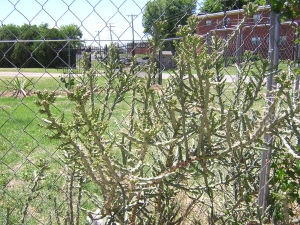
| Cylindropuntia imbricata var. arborescens Tree Cholla, Walking Stick Cholla, Cane Cholla
Oklahoma's tallest native cactus, reaching at least seven feet . Ours are clones of plants from the Black Mesa area of the panhandle. Completely hardy in (well-drained) zone 6 and probably colder. Beautiful magenta flowers in the spring. Shipped as unrooted cuttings. 6" +/- cutting $5.00 |
| Cylindropuntia kleinae Candle Cholla, Pencil Cholla
Another Oklahoma Native, much more delicately built than the Tree Cholla (but still very hardy), and even faster growing. Shipped as unrooted cuttings. 4" +/- cutting $4.00 |
![]() |
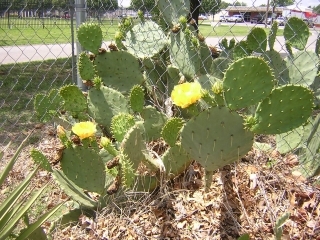
| Opunntia engelmannii var. alta Giant Prickly Pear
A huge prickly pear native to the Gulf Coast, but well suited to our zone 7 climate. It grows several feet tall and forms a woody trunk. (It would probably get even taller here, but the Oklahoma wind seems to knock it back every two or three years). This particular clone has been grown for decades in central Oklahoma and survived the 1980s--'nuff said. Shipped as unrooted cuttings. |
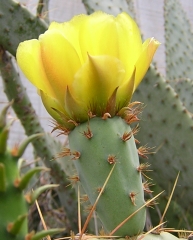
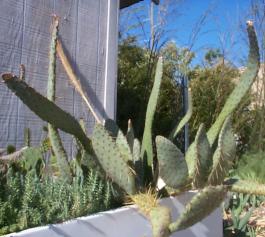
| Opunntia engelmannii var. linguiformis Cow-Tongue Cactus
This has been a champion grower for us in Oklahoma City--fast and tall with very little winter damage. Shipped as unrooted cuttings. 12" +/- pad $5.00 |
| Opuntia polyacantha Grizzly Bear Cactus, Starvation Cactus
Extremely cold-hardy prickly pear (native from Arizona, through the Oklahoma panhandle, all the way to the Arctic Circle--ours were originally from the tip of the 4" +/- pad $5.00 |
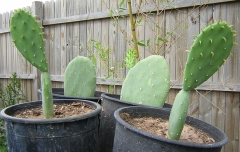
| Spineless Prickly Pear ?Opuntia engelmanni v. lindheimeri ?
The latin name with this one is our best guess, based on photos of other spineless Opuntia varieties. The original plant came from a fruit stand in South-central Texas. The other plants purchased there did not turn out to be hardy, but this one has done well with mid-single digit lows and highs in the teens. It has a very erect growth form and does not "lie down" in the winter. The ones offered currently are well-rooted one-gallon plants with two or more pads. Single un-rooted pad $7.50 |
| Lace Cactus Echinocereus reichenbachii
An Oklahoma native prized for its large (for a ball type cactus) size, great hardiness and huge pink blooms. $10.00 |
| Horse Crippler Echinocactus texensis
The Horse Crippler is the hardiest large "barrel" cactus. It has a low growing form that helps it avoid wind chill and conserve heat. It is the only barrel cactus native to Oklahoma. Even so, it needs perfect drainage or it will frequently rot during the winter. If possible, the best location in zone 7 is in a raised bed under an eave (to minimize winter moisture). The well-rooted plants we are shipping are about two gallon size, but can grow to a foot or more across. Temporarily out of stock--Due back in ???
We do have some Eagle Claw Cactus in stock, Echinocactus horizonthalonius . They are very similar to, but a bit smaller than the Horse Crippler, but just as hardy. $12.50 |
| Beaked Yucca Yucca rostrata
Yucca rostrata is one of the hardiest (and best looking) trunked Yuccas. There are rostratas all over Oklahoma that survived the 1980s undamaged. With excellent drainage and careful siting it will grow well into zone 6 and sometimes colder. We are shipping field-grown plants with about a foot of clear trunk. They will have limited roots and do best if potted up into a seven gallon container of cactus mix for a season before planting out, but we have often been successful just digging a hole and dropping them in here in central Oklahoma. Just make sure they have full sun and are not in a site where water will accumulate during the winter. These usually have between 8 and 18 inches of trunk. Due to their size and weight, Yuccas may be sent by Parcel Post or UPS. $85.00 Want to save some money? Not in a hurry? We also have small rostrata seedlings. In 5-10 years you can have a 2-4 foot plant for next to nothing. Y. rostrata, seedling $3.00 |
![]() |
| Thompson's Yucca Yucca thompsoniana A close relative of Y. rostrata that is a bit smaller, only growing to about 15 feet. Thompson's are (if you can believe it) even more cold hardy than rostrata. They also are more likely to grow multiple heads, looking something like a miniature Joshua Tree, Y. brevifolia. 3-4 foot $155.00 4-5 foot $225 |
![]() ![]() |
| Blue Yucca Yucca rostrata v. rigida Very similar to Y. rostrata in size and hardiness, rigida differs from rostrata in having a more blue color, and fewer leaves that are somewhat stiffer. Planting and care are the same as Y. rostrata. $85.00 |
![]() |
|
Long-Leaf Yucca Yucca linearifolia $95.00 |
![]() |
| Spanish dagger Yucca treculeana
A nice rigid Yucca, it grows larger and faster than Y. rostrata, but is not quite as hardy. Be careful where it is planted, as an encounter with one of the sharp-spined leaf tips can be very painful (or even dangerous for small children). Due to their size and weight, Yuccas may be sent by Parcel Post or UPS. $60.00 |
| Carneros Giant Dagger Yucca carnerosana One of the largest hardy Yuccas, this monster usually grows to a height of 10-20 feet, but can sometimes reach 30. It attains a massive trunk, between one and two feet in diameter. The crown can exceed six feet in diameter. It is now usually considered a form of Y. faxoniana, but it differs in several ways from its relative. Y. carnerosana has smoother, shinier leaves, distinct filaments on the margins, a fatter trunk (even as a juvenile) and most importantly in my experience, they root in better than Faxon's. Care must be exercised when choosing a planting site, as the huge dagger leaves should be kept well clear of walkways. $95.00 |
![]() |
| Aloe Yucca Yucca aloifolia A Gulf Coast native, Y. aloifolia is a bit more tolerant af moisture and shade than the desert species. It develops a narrower trunk than the others and a maximum height of around ten feet. It has nice stiff leaves and is (along with several other species) often called "Spanish Dagger." It is usually hardy to zero or below. We are currently shipping one-gallon plants. $10.00 |
![]() |
| Agave parryi One of the most cold-hardy Agaves available. Can eventually reach 20-30 inches in diameter Just a few in stock. $20.00 Sold Out | ![]() |
Desert Agave Agave deserti
Another blue/gray/green Agave. A bit smaller and not quite as hardy as A. parryi. It also has a bit smaller price. Limited supply.
$10.00
| Shin Dagger Agave lechuguilla Not as pretty as some of the blue-type Agaves, this is still a cool plant for the desert garden. It is also more tolerant of winter moisture than some of the other species, at least here in Oklahoma City. West Texas form. One-gallon size $15 3-5 gallon size $35
SOLD OUT 3-5 gallon $50 |
![]() ![]() ![]() |
| Variegated Agave Agave funkiana (?) Agave lophantha (?)
This is one of hardiest Agaves of all the ones we have tested here in central Oklahoma (and believe me, I have killed quite a few over the years). The original plant was purchased from a roadside vendor in East Texas and was labeled A. funkiana. It looks very similar to A. lophantha (which is native much farther North) so I don't know for sure what it is. What I do know is that it survives single digit temperatures, snow, ice storms and wet soil--even small offsets in above ground one-gallon pots aren't killed by bitter cold. Shipped as small offsets with some roots. $10.00
25 seeds $6.00 |
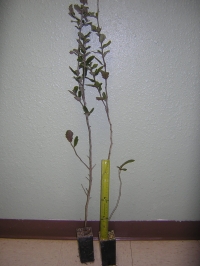
| Quartz Mountain Live Oak Quercus fusiformis 'Quartz Mountain' From the harsh environs of western Oklahoma near the dividing line between zones 6 and 7 comes this most northwesterly selection of the evergreen Live Oak. They are quite cold-hardy and drought tolerant when established. We are offering small plants, about one to three feet tall. $20.00 each |
![]() |
| Chisos Mountain Agave Agave havardiana
Another very hardy Agave for zone 7 (and colder, with good placement and drainage). Grows to over two feet in diameter. 3" pot Sold Out14-18" Specimen $120.00 18-24" Specimen $ 160.00 |
![]() |
| Mescal Agave neomexicana A slightly less expensive alternative to A. havardiana, but still very hardy. Some sources say it is good down to -20 F, with proper drainage. 10-14" Specimen $60.00 20"+ Specimen $125.00 |
![]() ![]() |
| Red "Yucca" Hesperaloe parviflora
Not a true Yucca, but a close relative that forms an attractive red bloom, held high above the plant. Rock-solid hardy here in central Oklahoma and probably in colder areas too. We are shipping very big one-gallon plants (really more like 3-5 gallon size) ready to go into the ground or larger containers. Much larger than pictured. $12.50 Seedling Red Yucca $1.75 Sold Out |
![]() |
| Water Hyacinth Eichhornia crassipes
The water hyacinth is one of the fastest growing floating plants for the pond. It is usually not winter hardy in zone 7 or colder, but it should still never be released into the wild, as it is a serious nuisance in warmer areas, clogging waterways and shading out native underwater plants. The dangling underwater roots make a great place for baby fish to hide and it is a very "hungry" species that acts as a natural water treatment plant, removing ammonia and other wastes from the pond. It multiplies quickly, so a single plant may spread to eventually cover a pond during a single season. It is best to remove them from the pond (the compost pile is a good destination) after the first frost, so they don't decompose in the water over the winter. It can be overwintered in a tub in a sunroom or greenhouse, but it does best in warm weather outdoors. It likes bright light and still water--it doesn't do well at the bottom of a waterfall. Please check your local laws. We won't ship water hyacinth to any area where it is illegal. If you have one in your cart and you live in a banned area, we'll have to cancel your entire order and you can resubmit it later, without the hyacinth. We ship good sized plants with pups. Usually available from April or May through October or November . $5.00 each 5 Plants for $15.00 |
| Airplants Tillandsia ionantha
These tiny Bromeliads are not winter hardy, but are great for terrariums and reptile tanks. (Actually they can take moderate freezes--I keep them in an unheated greenhouse--but I doubt they would survive below 20 degrees for very long). They can be tied or glued to driftwood to make attractive arrangements. Keep them in bright, diffuse light and water by spraying heavily about twice a week and allow to dry completely between waterings. Add a little dilute liquid plant food every month or so and they'll grow and reproduce "pups" that you can share. They have an attractive bloom that lasts for several days. $0.99 each $5.00 10-count |
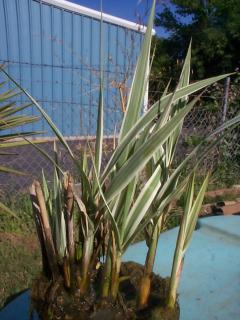
| Variegated Giant Reed Arundo donax 'variegata'
Tall (10-20') grass, unrelated to, but sometimes mistaken for bamboo. In our climate, the tops usually die back each winter, but it always returns bigger and better from the roots the following year. In warmer climes, the top will survive, but will look better if it is mowed down and allowed to regrow. The variegation is great in the spring and early summer, but fades out to mostly green by late summer and fall. This remarkable plant is at once a xeriphyte, mesophyte and a hydrophyte, meaning that (once established) it can survive with almost no water, with regular rainfall or watering, or even with roots submerged as a pond plant! Check your local laws, as Arundo can be very invasive in riparian habitats and is a nuisance in some areas. Sold as leafed-out, rooted cuttings. $5.00 |
| Silver Mazari Palm Nannorhops ritchiana
Contrary to what you may have read, this is not the world's hardiest palm. Not even in the top five, IMHO. But it is an attractive palm that was quite rare in cultivation until a few years ago. These are small "liner" sized plants, about 3-8 inches with 2-4 leaves that should be potted up into one-gallon containers. They seem to do well into the mid teens (in well drained soil), but I haven't seen one survive below ten degrees without protection. Orders for three plants will usually receive two in one cell, as pictured. $5.00 each Sold Out |
| Dwarf Palmetto Sabal minor "McCurtain' It has been a while since we offered this native Oklahoma palm. They are in one-gallon containers, but really need to go into the ground or larger pots. They are exceptionally hardy, but only reach about three to five feet, half the size of Sabal louisiana. We don't have too many of them, so there is a limit of one per customer. Sabal minor 'McCurtain', one-gallon $30.00 (Sold Out) |
![]() |
| Sabal birmingham
This is it, the legendary palm that survived in Birmingham, Alabama for decades before being moved and succumbing. The Tulsa specimen (parent of the ones we're selling, pictured here) received only 20% leaf damage in 1996 when the official temperature dropped to eleven degrees below zero! The plants we are offerng are five gallon specimens and do best if repotted into seven gallon containers and kept in bright diffuse light, high heat and high humidity (a greenhouse is ideal) to recover before being planted into the landscape. If you must put them in the ground, your bestchance for success is to cut off all but one or two center leaves to minimize water loss until the roots can recover. Better yet, if you can drive to Oklahoma City, they are cheaper and you can get one in the pot (not bare-root) and plant it right away with less risk. But, since not everyone can drive here, we offer these for you to try. $65.00 each |
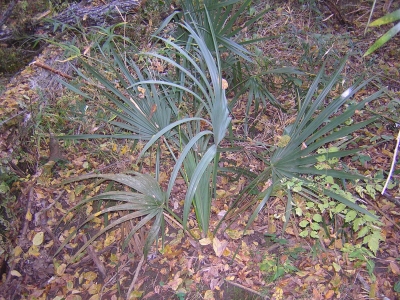
| Sabal louisiana 'Stiff-leaf'
Currently in one-gallon containers, most with strap leaves. Nice plants with good root systems. $15.00 each |
| Windmill Palm Trachycarpus fortunei One of the most celebrated hardy palms. It can do well in zones 7 and higher, although it is best to provide some protection on the coldest nights in our area. I have several windmills, but I have lost many small, unprotected ones over the years when temperatures stayed below 10 degrees for long periods. My rule of thumb is to wrap the trunk with a plumber's heat tape and some insulation any time the forcast is below 15 degrees. I have never lost one protected this way. Small seedling $2.50 |
| Khasia Hills Palm Trachycarpus martianus Not a very hardy palm (said to be only 15-25 degrees), but a very collectible relative of the Windmill. We only have a limited number of these, but the price is right if you want a few. Seedling $5.00 |
| Mediterranean Fan Palm Chamaerops humilis This species does well only with protection in central Oklahoma. It is usually fine above 10-15 degrees, but damages badly in single digits. It can be completely defoliated and still regrow a new crown the next season, but repeated damage for two or three years may kill it outright. We are stocking these for folks in zone 7b and warmer, and anyone wanting an inexpensive palm to grow with protection in cooler areas. Seedlings, Green form $2.50 Liners, Silver form 'cerifera' (reputedly hardier than the green form) $2.50 One gallon size seedlings, green form $5.00 |
|
Serenoa repens, Saw Palmetto Sold Out |
| Rhapidophyllum hystrix Needle Palm
Famous for being the most cold-hardy palm in the world. (Also one of the slowest-growing) These are two year-old plants, about one-gallon container size, slightly smaller than pictured. $20 each |
SEED SALES
Poncirus trifoliata "Flying Dragon" Hardy Orange, Trifoliate Orange
The hardiest of all Citrus/Citrus relatives, primarily grown as a commercial rootstock, it makes an interesting specimen plant or hedge itself. The "Flying Dragon" cultivar has curved thorns. Also a good barrier plant, due to its vicious thorns. Don't try eating the attractive miniature oranges, though. Poncirus seeds will not be sent to California, Texas, Florida or any other Citrus-producing state. We also have the standard, straight-thorned variety. If you prefer it, make a note with your order.
10-count seeds, $2.50
25 seeds $6.00
Seeds of Premium Palm Specimens
| Rhapidophyllum hystrix Needle Palm Our big Needle didn't produce any good seeds this season, so I bought these. They look good and I'll be starting some myself to make sure they have good viability. There are no refunds, but if mine don't germinate" at least 20%. I will replace any seeds ordered with fresh ones next winter (assuming we have a good crop in 2008 ). Save your invoice or packing list, just in case. Germination is trickier than with Sabal, and percentages will be lower (20-60 %, on average). These are hard-to-find, even from field-collected sources, much less cultivated plants, and are priced accordingly. $0.50 each Special--Limited Time (Extras will not show up on order form, but will be added to your shipment) Buy 20, get five FREE Buy 50, get 20 FREE Buy 100, get 50 FREE
|
| Sabal minor 'McCurtain' We are offering a few surplus seeds of one of the most sought-after ecotypes of Sabal minor. McCurtain County, Oklahoma is the most northwesterly population of any Sabal palm. The native populations have been as low as -11 degrees in recent history and cultivated plants have survived more than 20 degrees below zero. They seem at least as hardy as the legendary northeast Texas plants from nearly 150 miles farther south, and tend to grow faster and larger. Due to the limited supply, there is a limit of 20 seeds per customer. Also, if you have ordered seeds from us before, you know we usually give a generous overcount. You should get a few extra 'McCurtains' with your order, but please don't be upset if you don't get as many extras as with most other seed orders. Sabal minor 'McCurtain' 10 count seeds $4.00 |
The seeds offered below are collected from specimens that are the best of the best. They are far above average in hardiness and or size. Also included are hard to find rare ecotypes.
All seeds are pre-cleaned of fruit, with the exception of some of the Needle Palm seeds. Shipping and handling charges in the USA are $5.00 for your entire order, regardless of how many items you have in your cart.
| Sabal "Stiff Leaf"
This palm is not quite as tall as some of the other louisianas, but it has nice, large leaves and doesn't damage in ice and windstorms like many of the other louisianas. Another bonus is that it develops typical split leaves at a much smaller size when container grown. One-gallon 'Stiff Leaf' plants actually look like palms, not fat grass :) 25 seeds $6.00 |
| Premium Palm #2 (zone 7 and warmer only) A huge Sabal louisiana that was planted outside as a seedling in 1990. This palm has been very robust growing developing a short trunk. This specimen survived the -3*f freeze of 1996 with 40% leaf damage so I do not recomend it in areas colder than zone 7, but if you want a fast growing and trunking Sabal louisiana for zone 7 and warmer this palm is a great choice. 25 seeds - \\$6.00 |
| Premium Palm #3 (zone 6b in warm microclimate?) A very nice Sabal louisiana that was planted outside around 1992 from a 5 gallon container. It grew quickly and started producing seeds very young. I used its seeds for my local growing operation and it's offspring are nice as the parent. This palm survived the 1996 record low of -3*f without any damage. 25 seeds - \\$6.00 |
| Premium Palm #4 (zone 6a in warm microclimate) These palms are Sabal minor that were collected from northeast Texas just south of Carthage around 1987. While not the largest palm they make up for size in cold hardiness. These two specimens survived a record low in 1989 of -8*f undamaged. I had specimens of Sabal minor collected from Florida that recieved 80% leaf damage at -8*f but the northeast Texas ecotype were untouched. Small seed grown offspring of these two palms were untouched at -3*f in 1996. If you are in zone 6 this is my recommendation for a palm that may survive longterm in your area. 25 seeds - \\$6.00 50 seeds - \\$10.00 |
Premium Palm #5 (zone 6a in warm microclimate) To the right is a picture of the native Sabal minor population near zone 7b Warren Arkansas. I have 4 cultivated specimens of this ecotype that produce many seeds every year. This ecotype of Sabal minor is quite hardy and should survive well into zone 6. 25 seeds - \\$6.00 |
| Premium Palm #6 Sabal louisiana (zone 6b in a warm microclimate) This plant was installed in 1992 as a one gallon (along with two others), then they were all moved to a new yard in 1994. It showed little transplant shock and has since grown 2-3 times as fast as the others. 25 seeds $6.00 50 seeds - \\$10.00
|
| Cheap, Uncleaned Sabal louisiana seeds These are from average plants growing here in Oklahoma City, still on the stalks and with the fruit intact. Good for growing a small forest of palms at a low cost. You will get faster germination if you remove the fruit (but they seem to do OK in the wild without any help). You'll receive 1/2 pound of seed and stalk. The exact number of seeds will vary with size, moisture content, stem thickness etc. but will usually be around 500 to 700 seeds total. Available while quantities last. Sabal louisiana seeds on stalk, 1/2 lb. $20 |
Heat Tape--Sabal seeds germinate best at about 85 degrees F. These ultra-thin tapes use a flexible element sandwiched between two sheets of Mylar. Place under your seed beds for optimum germination rates. Plugs directly into 110v outlet. Available in 4" and 10" widths.
| 4"x12" \\$13.00
4"x24" \\$17.00 4"x36" \\$21.00 4"x48" \\$25.00 4"x96" \\$41.00 |
| 10"x12" \\$15.00
10"x24" \\$20.00 10"x36" \\$25.00 10"x48" \\$30.00 10"x96" \\$50.00 For custom lengths, call or E-mail for a quote. |
| Thermometers--An inexpensive but accurate glass thermometer for measuring the exact soil temperature in your seed beds.
Thermometer-- \\$2.00 |
| Alligator Alley/Amazing Gardens T-Shirt Available in Large, Medium and Small only. Please specify which one you need, or you'll get what we have the most of. We also have a more reptile oriented shirt available here. $15 |
![]() |
Any questions please contact bryan@alligatoralley.com
Phone 405-949-2553
|
|
Alligator Alley
4636 NW 10th Street
Oklahoma City, OK 73127
405-949-2553
Email:Bryan@AlligatorAlley.com